
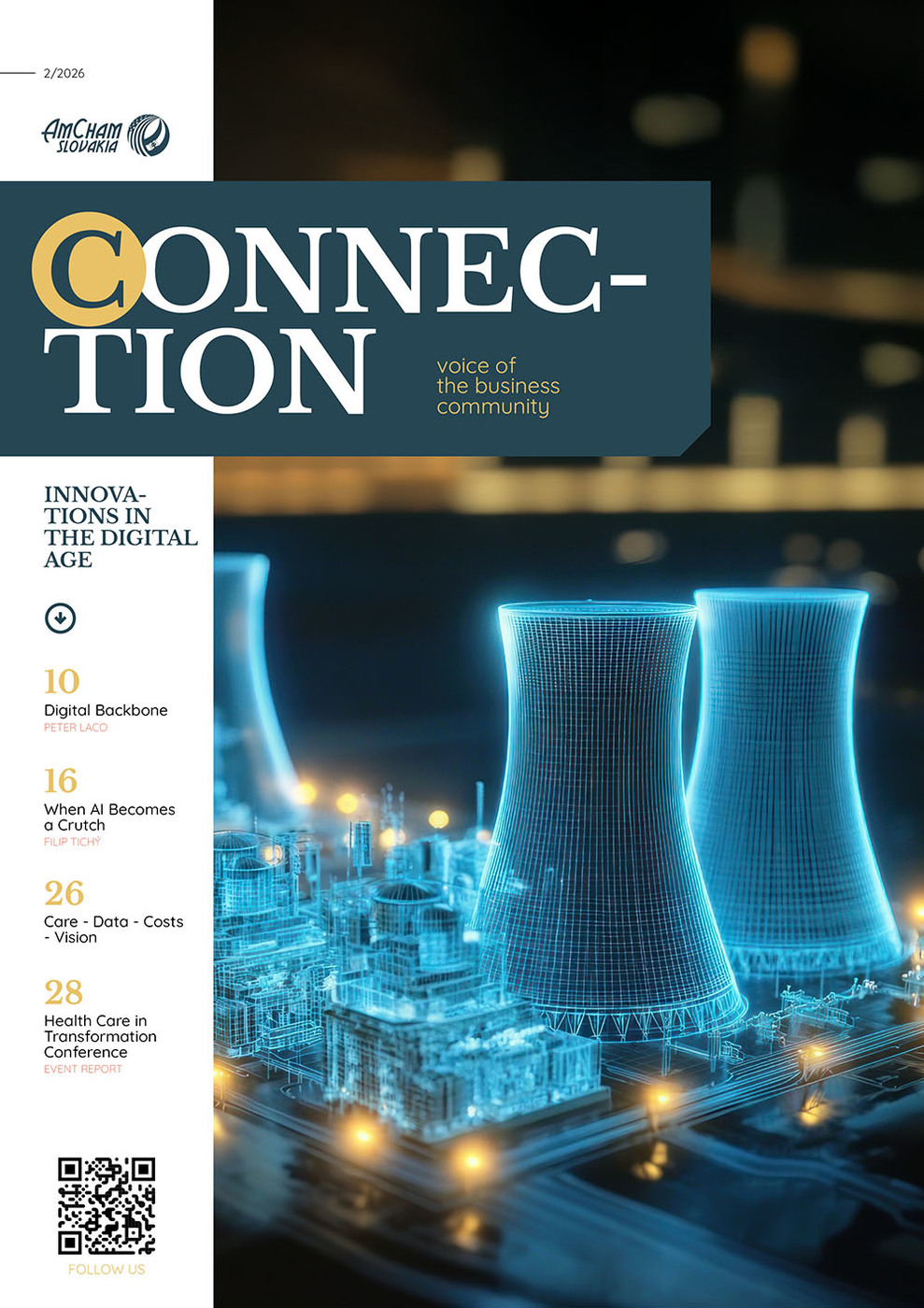
Download PDF
- Safeguarding Trust in a Digital Age
- Digital Health, Innovation & Data
- Beyond Compliance: Leading the AI Revolution in Central Europe
- The Dream of a New Economy
- Why Agentic AI Projects Fail?
- AI Agents Need Roads
- Rethinking Processes Before Tech
- Contracts Enter the AI Era
- AI Strategy & Compliance
- When AI Becomes a Crutch
- Work and Life Connections
- Securing Web Applications
- Technology Behind Olympic Excellence
- Visa Intelligent Commerce
- Europe’s Industrial AI Cloud
- EU Cyber-security Update
- Digital Backbone
- The Courage to Experiment
- Innovating Together
Innovation in the Digital Age
Safeguarding Trust in a Digital Age
In an era defined by digital interdependence, geopolitical volatility,
and rapidly evolving cyber threats, national security extends far beyond
physical borders. It includes the protection of digital infrastructure,
communication networks, information systems, and sensitive data. In
Slovakia, this responsibility lies with the National Security Authority
(NSA), which safeguards classified information and oversees the systems
and networks that process it.
Digital Health, Innovation & Data
Europe is undergoing a profound demographic and technological shift.
Ageing populations, rising chronic disease burdens, and growing
shortages of healthcare professionals are putting systemic pressure on
already stretched health systems, including Slovakia’s. At the same
time, rapid advances in artificial intelligence, robotics, automation
and data analytics are opening new possibilities to deliver care that is
more personalized, proactive, and efficient. In this context, digital
health is no longer an optional innovation agenda - it is becoming a
necessary condition for a resilient, accessible, and sustainable
healthcare system.
Beyond Compliance: Leading the AI Revolution in Central Europe
For decades, Slovakia’s economic growth was fueled by physical labor and
industrial capacity. We became the “automotive heart” of Europe, a
title that brought stability but also a dangerous level of path
dependency. Today, that model is under siege. The fundamental
transformation Slovakia is facing is driven by a shift from hardware to
software, from assembly lines to algorithms. As we enter 2026, the
question is no longer whether we will adapt to the digital age, but
whether we will have the courage to lead it.
The Dream of a New Economy
The last century produced many remarkable scientists, but only a few shaped the world as profoundly as János Lajos Neumann, known globally as John von Neumann. A Budapest-born émigré, brilliant mathematician, and co-founder of computer science and game theory, von Neumann believed that the best model of human decision-making was not chess, but poker.
Why Agentic AI Projects Fail?
Agentic AI projects fail when the business case is missing, the data foundation is unproven, and delivery and adoption aren’t treated as a transformation. This article outlines five recurring failure patterns and a stage-gated playbook to scale successfully.
AI Agents Need Roads
The past two years have produced a familiar pattern in many leadership teams. Someone sees an impressive AI demo, a competitor announces an “AI agent strategy,” and suddenly the pressure rises to deploy autonomous agents everywhere. The conversation quickly turns into a race: which model to choose, how fast to roll out.
Rethinking Processes Before Tech
In the rush to digitize, one truth remains: (IT) technology doesn’t fix processes, it reflects them. Without first understanding and redesigning how work gets done, even the best tools risk scaling inefficiencies. This article explores the core principles and frameworks that underpin effective, intentional process transformation.
Contracts Enter the AI Era
Most organizations manage billions in contractual value, yet cannot instantly answer a simple question of “What are we actually obligated to do right now?” Contracts sit at the heart of every business relationship, governing value exchange, risk, and accountability. Yet for many organizations, they remain underutilized and poorly understood. In an era of digital transformation, contracts are emerging as one of the most valuable, but untapped, enterprise data assets.
AI Strategy & Compliance
Slovakia stands at an inflection point. As supply chains, capital and talent shift across Europe, the businesses that combine disciplined governance with swift adoption of AI are more likely to secure outsized gains in productivity, exports and competitiveness.
When AI Becomes a Crutch
Research from the University of Economics in Bratislava shows that 97% of students already use AI, yet most do so in ways that weaken rather than strengthen their abilities. For companies seeking capable graduates, this is a challenge that cannot be ignored.
Work and Life Connections
Achieving professional success often involves navigating many challenges.The responsibility towards their families and their employees makes business leaders carefully consider each minute of their day. We want to know how they like to spend their time out of work, what inspires them and motivates them.
Securing Web Applications
The digitalization of business has brought companies new opportunities, but also new risks. Web portals, customer zones, and online applications are now key tools for communicating with customers, while at the same time becoming some of the most frequent targets of cyberattacks.
Technology Behind Olympic Excellence
From athlete preparation to global broadcasting, modern Olympic Games rely on complex digital systems working seamlessly behind the scenes. While spectators focus on sporting moments, technology quietly enables fairness, safety, scale, and connection across one of the world’s most demanding live events.
Visa Intelligent Commerce
The introduction of new technologies is not only transforming online shopping but also reshaping the way we live. We compare prices in seconds, book holidays from our phones, and pay with a single tap. But what if the next evolutionary step in digital commerce is not faster browsing, but no browsing at all?
Europe’s Industrial AI Cloud
Europe is accelerating its journey toward technological independence with the launch of Deutsche Telekom’s Industrial AI Cloud — a next-generation platform combining powerful AI computing, sustainability, and trusted European governance. Built through international collaboration and strong engineering expertise from Slovakia, the initiative opens new opportunities for businesses and public institutions to innovate securely at scale.
EU Cyber-security Update
In January 2025, Slovakia officially transposed the NIS 2 Directive into its national cybersecurity legislation, introducing a new registration obligation for companies that meet defined size criteria and operate within designated regulated sectors. As expected, this step brought a noticeable level of uncertainty to the market.
Digital Backbone
As digital transformation accelerates across industries, connectivity and cybersecurity are becoming strategic business priorities rather than technical concerns. In this interview, Peter Laco, Chief Commercial Officer Enterprise at Slovak Telekom, explains how the Slovak B2B market is evolving, why trust and infrastructure matter more than ever, and where enterprise digitalization is heading.
The Courage to Experiment
Imagine an organization equipped with cutting-edge AI tools, advanced analytics, and digital platforms - yet hesitant to test a new idea because it might fail. In today’s Digital Age, this contradiction is more common than we admit.
Innovating Together
In today’s rapidly evolving digital age, innovation is no longer
confined within national borders. It is built across ecosystems, supply
chains, and partnerships that span continents. This reality was front
and center during recent discussions in Brussels, where AmCham Slovakia
joined fellow AmChams in Europe to reflect on the future of EU–US
economic cooperation.
Follow us