
There is a widespread assumption that the more students master AI tools, the better prepared they will be for professional life. A recent study conducted by the Faculty of International Relations at the University of Economics in Bratislava (FMV EUBA), led by Professor Bećirović, tells a more nuanced – and in parts, concerning – story. The research surveyed 531 students across multiple programs. The headline finding is not a surprise: 97% of students already use AI in some form, with ChatGPT dominating almost completely. But frequency of use is a poor indicator of value. The question the research set out to answer was not whether students use AI, but how – and what that means for their development.
When AI Does the Thinking, Students Stop
The study found a clear negative relationship between passive AI use and cognitive engagement. Students who rely on AI primarily to generate ready-made answers show reduced critical thinking, weaker problem-solving habits, lower effort invested in their studies, and greater emotional disengagement from the learning process. Paradoxically, even students with strong technical understanding of AI tend to engage more passively, the better they know the tool, the more readily they delegate thinking to it.
This is not simply an academic concern. Companies across Slovakia – in financial services, consulting, and other knowledge-intensive sectors – compete for people who can analyze complex situations, synthesize information, and form independent judgments. AI can support all these capabilities. But it cannot replace them, and it will actively erode them if used as a substitute rather than a support.
The Protective Factor: Critical Thinking
The research also identified what works. Students who approach AI outputs critically - verifying information, considering context, questioning accuracy - show significantly higher cognitive and behavioral engagement. They also use AI more effectively and purposefully. Critical thinking is not in conflict with AI adoption; it is the condition that makes AI adoption genuinely valuable.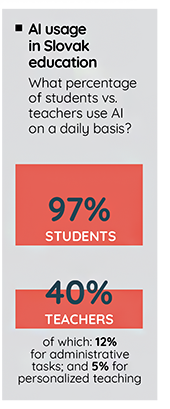 The same dynamic applies to ethical awareness. Students who consider the ethical implications of using AI, such as questions of fairness, transparency, and responsibility, demonstrate deeper engagement with their studies overall. In this context, ethics is not a philosophical abstraction. It is a practical skill that shapes how technology is used, and ultimately, what kind of professional a person becomes.
What This Means for Slovakia’s Employers
The skills gap that AI is likely to widen is not primarily technical. Most employees can learn to use AI tools quickly. What is significantly harder to develop, and much easier to lose, is the capacity for independent reasoning, synthesis, and creative problem-solving. These are the capabilities that will determine whether Slovakia’s workforce is able to leverage AI as a competitive advantage or simply become dependent on it.
AI will commoditize many professional services and lower barriers to entry across industries. In this environment, the differentiating factor will not be access to AI, everyone will have it. It will be the quality of human judgment behind it. Companies that understand this will prioritize developing people who know not just how to use AI, but when to question it, when to override it, and how to take responsibility for the decisions it informs.
An Unmanaged Transition Is Already Underway
What makes the FMV EUBA research particularly timely is its reminder that this transition is not waiting for a strategy. Students are already using AI extensively, without guidance from institutions that are themselves underprepared. Fewer than 40% of teachers use AI in creating educational content; only 5% use it to personalize instruction. In the absence of structured frameworks, students are filling the gap with habits that may serve them poorly in professional life.
Slovakia has taken a first step with the Ministry of Education’s Plan for Responsible AI Use in Education. But informal discussion and isolated institutional responses are insufficient. A coordinated national approach – integrating AI literacy into curricula, investing in teacher development, and establishing shared standards – is needed urgently.
The Real Opportunity AI has genuine
Transformative potential in education. If introduced thoughtfully, it could free students from rote memorization and routine tasks, creating space for deeper inquiry and genuine skill development. The ancient Greek word scholē, from which “school” derives, originally meant free time for reflection and the pursuit of one’s own potential. Education was not conceived as vocational training, but as human development. AI, used well, could help us return to something closer to that original purpose.
That outcome, however, requires precisely the skills that unguided AI use is currently undermining. The research from FMV EUBA is a useful reminder that technology does not determine its own impact. We do, through the choices we make about how it is taught, governed, and used.
Filip Tichý, Partner, Grant Thornton Slovakia

Follow us