
Download PDF
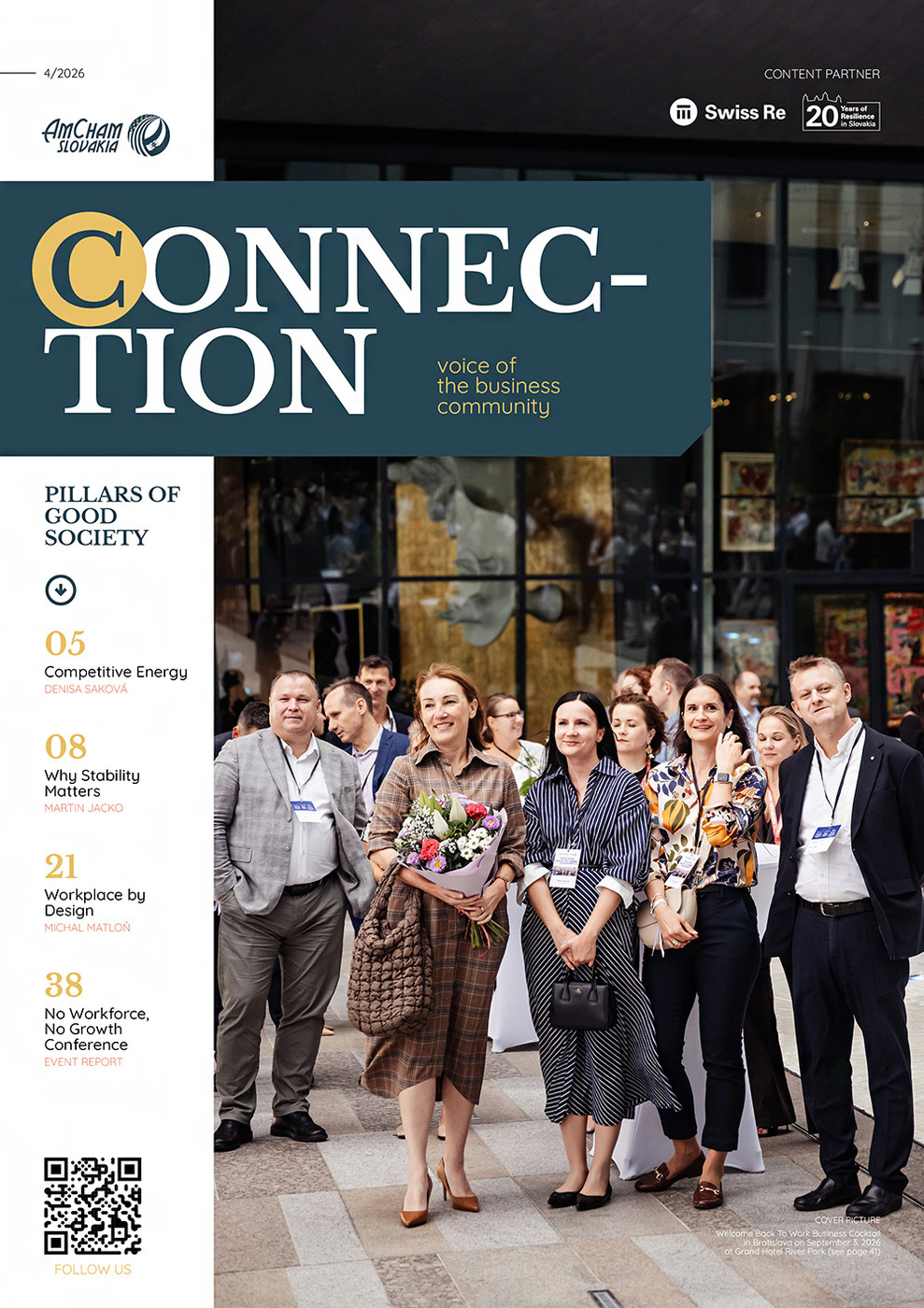
- Competitive Energy
- The Human Edge
- The Stability Advantage
- Why Stability Matters
- Diversity Needs to Be Seen
- Built For More Of Us
- Why the Best Teams Win
- Equal Pay in Slovakia
- Human-Centered AI
- Healthy Years Matter
- Where Wellbeing Begins
- Twenty Years of Resilience
- Healthier People, Stronger Slovakia
- Making AI Accessible Responsibly
- Cities: The Overlooked Pillar
- Workplace by Design
- New Rulebook for Green Transition
- Purpose Beyond Business
- Who Will Care for Slovakia?
- Value Through Purpose
- ESG Moves Beyond Reporting
- AI, Impact, Opportunity
- Heat from Below
- Powering Competitiveness
- Growing Responsibility
- Work And Life Connections
- Nature Meets Comfort
- Quantum’s Business Breakthrough
- Sustainability Means Resilience
Pillars of Good Society
Competitive Energy
Energy is the cornerstone of any economy. If we want to talk about the
competitiveness of Slovakia and Europe, we must also talk about how much
energy costs, where it comes from, and whether we will have enough of
it 10 or 20 years from now.
The Human Edge
Rapid technological change, shifting demographics, and evolving employee expectations are reshaping the world of work faster than most organizations can adapt. Pavlína Louženská, trend forecaster and founder of TrendBrews, discusses the signals business leaders should watch and the skills that will matter most in an AI-driven future.
The Stability Advantage
In today’s global economy, a country’s competitive advantage is no longer determined solely by labor costs. For multinational companies and foreign investors, institutional predictability is what ultimately sets a market apart. A stable regulatory environment, efficient public administration and transparent rules attract high-value FDI, support innovation and provide reliable market access.
Why Stability Matters
Institutional stability rarely makes headlines, yet it is one of the foundations of economic growth and investment. Martin Jacko, Chairman of the Steering Committee of the Rule of Law Initiative, explains why legal certainty, predictable policymaking, and effective institutions are essential for Slovakia’s long-term competitiveness.
Diversity Needs to Be Seen
Diversity can strengthen business - but only when employees see it in everyday work. Our survey across eight countries shows that the main challenge is not resistance to inclusion, but a gap between formal commitments and what people actually experience, understand, and trust.
Built For More Of Us
Accessibility is often treated as a specialist HR topic, something activated when an employee discloses a disability or requests an accommodation. But what if designing work for people who function differently is actually one of the best ways to design better work for everyone?
Why the Best Teams Win
As a passionate football fan and a permanent ticket holder, I regularly watch matches from the stands. Not long ago, I attended a game that was decided by a single goal. While most fans were celebrating the player who scored the winner, what stayed with me was the work of the entire team behind that moment.
Equal Pay in Slovakia
The law is in force and the ministry’s methodology is out. The work that decides whether companies get this right happens elsewhere.
Human-Centered AI
As artificial intelligence reshapes workplaces and societies, its successful adoption depends as much on people as on technology. Maria Bielikova discusses how responsible AI leadership, trust, inclusion, and collaboration across business, education, and government can help strengthen competitiveness while advancing the social dimension of ESG.
Healthy Years Matter
We work for decades, but enjoy too few years in good health. In Slovakia, healthy life expectancy remains significantly lower than overall life expectancy, while an ageing workforce is placing new demands on employers. As healthcare systems come under increasing pressure, companies have a growing role to play in helping employees stay healthier for longer.
Where Wellbeing Begins
People stop speaking openly. Problems are discussed behind closed doors instead of being addressed directly. Employees become reluctant to admit mistakes. Trust declines. Changes introduced by management meet increasing resistance. People may continue delivering results, but beneath the surface stress, disengagement and frustration are growing. Do you have to imagine this scenario, or have you experienced it?
Twenty Years of Resilience
As Swiss Re celebrates 20 years in Slovakia, its Bratislava location has grown from a small local team into an important expert hub within the Group’s global network. Managing Director Lucia Gröneová reflects on that journey, the evolving risk landscape, and the skills that will define the future of the industry.
Healthier People, Stronger Slovakia
Healthcare is too often discussed purely in terms of cost: hospital debt, reimbursement pressures, rising expenditure. But this framing misses the point. Healthcare should not be a spending category listed for reductions. It is one of the most important investments a country can make in its economic future1.
Making AI Accessible Responsibly
As digital technologies transform economies and societies, sustainability is increasingly about more than emissions and climate targets. In this interview, Miroslava Remenárová, Head of Public Affairs and Sustainability at Slovak Telekom, discusses the intersection of ESG, artificial intelligence, trust, digital inclusion, and the role technology can play in building a stronger society.
Cities: The Overlooked Pillar
Discussions about economic resilience and competitiveness often center on technology, capital, and regulation. Yet one of the most underappreciated determinants of Europe’s competitiveness remains the places where people live, work, and connect: our cities. City quality shapes health outcomes, social cohesion, and everyday life directly, so competitiveness cannot rest on technology and capital alone.
Workplace by Design
As organizations rethink the role of the office in a hybrid world, workplace design is becoming a strategic business issue. Michal Matloň, Workplace and Environmental Psychology Consultant, explains how behavioral science can help create environments that support focus, collaboration, well-being, and a stronger sense of belonging.
New Rulebook for Green Transition
Green transition is entering a new phase. From 27 September 2026, businesses across the EU face a fundamentally different set of rules on how they may talk about sustainability.
Purpose Beyond Business
Lasting community impact takes more than good intentions. At Swiss Re Slovakia, we have learned that community impact is strongest when employee engagement, strategic partnerships and measurable outcomes come together around a common purpose.
Who Will Care for Slovakia?
Slovakia is ageing faster than almost any country in the European Union. Within a generation, nearly one in three residents will be a senior. Yet the workforce meant to care for them – nurses, home carers, social workers – is shrinking just as quickly. Few are prepared.
Value Through Purpose
For years, companies have been asked to become more responsible. They have developed ESG strategies, sustainability reports, employee programs and community partnerships. But most businesses no longer need to be convinced that ESG matters.
ESG Moves Beyond Reporting
ESG has become increasingly important for businesses, driven not only by investor expectations and customer demands but also by regulation. A growing number of EU laws are transforming sustainability from a voluntary commitment into a legal obligation, requiring companies to rethink how they operate.
AI, Impact, Opportunity
Jan Melichar, Citi Country Officer and Banking Head in Slovakia, reflects on how innovation, AI, and community engagement are shaping the future of youth opportunity, and why Citi’s commitment to social impact runs deeper than philanthropy alone.
Heat from Below
Geothermal energy represents a significant renewable energy source with considerable potential to contribute to the decarbonization of the district heating system and enhance the security and sustainability of heat supply in the city of Košice.
Powering Competitiveness
For many companies, electricity is no longer simply an operating cost. Volatile prices, geopolitical uncertainty, and pressure to decarbonize have turned energy procurement into a strategic question. Corporate Power Purchase Agreements (PPAs) could provide Slovak businesses with another tool to manage that challenge.
Growing Responsibility
Today, the digital economy is an integral part of the functioning of companies, public institutions and households. Every day, new websites, services and digital platforms are created that change the way we work, do business and communicate.
Work And Life Connections
Achieving professional success often involves navigating many challenges.The responsibility towards their families and their employees makes business leaders carefully consider each minute of their day. We want to know how they like to spend their time out of work, what inspires them and motivates
them.
Nature Meets Comfort
As expectations of premium living continue to evolve, buyers are increasingly looking beyond prestigious addresses and focusing on privacy, nature, and quality of life. Michal Mrník, Partner and CEO of SORIA Development, shares his perspective on emerging residential trends and the vision behind Prémiové Vily in Záhorská Bystrica.
Quantum’s Business Breakthrough
Quantum computing has long promised to solve problems beyond the capabilities of traditional supercomputers. That promise is now beginning to translate into measurable scientific progress. IBM and Israeli startup Qedma Quantum Computing recently announced a major step toward this reality, demonstrating that commercially available quantum systems can model physical phenomena beyond the reliable reach of leading classical approaches.
Sustainability Means Resilience
Sustainability is no longer a conversation happening on the side of
business, it is increasingly a conversation about how business itself
will function. At AmCham’s No Workforce, No Growth conference, we looked
at the social side of competitiveness - workforce resilience, workplace
culture, equal pay, cities and quality of life. A few weeks later, at
Climate Week NYC, the conversation shifted to energy systems, climate
technologies, AI infrastructure, financing, insurance, geothermal,
nuclear and the resilience of supply chains. Different topics, perhaps,
but not different worlds.
Follow us