
Just a few years ago, ESG was primarily a topic for specialists. Today, it has reached boardroom level. What do you think has driven this change?
Sustainability has gradually become a matter of long-term resilience and competitiveness. Energy intensity, resource availability, technological change, cyber risks and the ability to attract talent - all these external factors have a direct impact on how a company operates and on its value.
Regulation has also played a role. It has brought a consistent framework, transparency and measurability.
So has it delivered practical benefits?
ESG translates into investment decisions, product development, supply chain management and people management. The difference between ESG as a formality and genuinely responsible business lies precisely in whether it influences a company’s day-to-day decisions.
How can we ensure that ESG becomes a genuine part of business strategy and extends beyond reporting?
Reporting is necessary because, without data, we cannot assess progress or communicate results credibly. The problem arises when the report becomes the objective rather than a tool.
ESG must have clear ownership within the company, specific objectives and a link to investment decisions. If, for example, environmental criteria are not considered when modernizing the network, purchasing technology or selecting suppliers, a company may have a high-quality sustainability report, but its business is not actually changing.
The second prerequisite is a willingness to speak not only about successes, but also about unresolved challenges. Credibility does not come from claiming that a company is perfect. It comes from showing transparently what it has achieved, what it has yet to achieve and which indicators it will use to assess further progress.
At Deutsche Telekom Group, our ambition is therefore to establish sustainability as a business principle and a core element of value creation, rather than as the isolated agenda of a single department. When sustainability is mentioned, most people think of climate targets and emissions. Why should we be talking much more about the social dimension of ESG as well?
Because a sustainable society is not merely low-carbon. It must also be inclusive, safe and prepared for technological change.
Digital technologies influence how we learn, work, communicate and access services. However, if some people lack access to technology, the necessary skills or the confidence to use it safely, digitalization may deepen existing inequalities even further.
What does this mean for technology companies?
For technology companies, this creates a broader responsibility. Building networks and delivering services is not enough. We need to ask who is able to use them, who benefits from them and who might otherwise be left behind. At Telekom, the social dimension of ESG therefore encompasses areas such as digital education, the protection of children and older people, online safety, service accessibility, and a culture of respect within the company.
A sustainable digital transformation should be a transformation for people, not merely a transformation of technology.
Which trend do you believe will have the greatest impact on ESG over the next decade? Will it be regulation, artificial intelligence, the energy transition, or something else entirely?
In my view, the most significant trend will be the convergence of technology, sustainability and trust.
Artificial intelligence can help us use energy more efficiently, optimize operations and make better decisions. At the same time, however, it raises questions concerning resource consumption, data protection, transparency, human oversight and equal access to its benefits.
It will therefore not be enough to use AI to accelerate sustainability. We will also need to ensure that AI itself is used sustainably and responsibly. Deutsche Telekom’s strategic priorities describe this dual perspective as scaling sustainability through AI while scaling AI sustainably.
The winners will not be the companies with the greatest number of technological solutions, but those that can deploy them credibly and safely, with clear benefits for people. Technology creates new opportunities, but also new risks. What do you consider the greatest challenge in building trust in the digital world?
The greatest challenge is the widening gap between the pace of technological development and people’s ability to understand what is happening with their data and the decisions that affect them.
Artificial intelligence is becoming a routine part of everyday life. What responsibility do technology companies bear in ensuring that AI serves people and whole society in a responsible way?
There are three fundamental responsibilities: making technology accessible, explaining it, and setting safe boundaries for its use. AI can increase productivity, facilitate access to information and help people manage everyday tasks. Access alone, however, is not enough. Without digital literacy, critical thinking and transparent rules, the same technology can deepen inequalities or erode trust.
What role does education play?
A very important one. Having access to technology is one thing; knowing how to use it is another. At Slovak Telekom, we combine access to AI with education. Since the end of the summer, we have been offering Magenta AI free of charge in our Telekom app to everyone, including those who are not our customers. No one should be excluded from the opportunity to use modern technology. We support AI literacy and the responsible use of AI in education, and in the new school year our nationwide ENTER School program is introducing a new module focused on the responsible use of AI.
Internal AI governance is equally important. Every system must have a clearly designated owner, assessed risks and a mechanism for human oversight. The objective should not be to replace human judgment at all costs. It should be to expand human capabilities in a way that remains safe, fair and controllable.
The digital divide remains one of the greatest societal challenges. Why should companies play an active role in strengthening digital skills and digital inclusion?
Digital inclusion is an investment in a well-functioning market and society. A person without sufficient digital skills may struggle to communicate with public authorities, use banking or healthcare services, apply for a job, or recognize an online scam. This reduces their independence while creating costs for families, businesses and public institutions.
Both companies and the state have an interest in ensuring that customers and citizens can use services safely and confidently. They also need a workforce that is prepared for technological change. Closing the digital divide therefore supports resilience, employability and competitiveness.
Older people, children, parents and people living in the regions deserve particular attention. Each group needs a different type of support. Effective digital inclusion does not begin with technology, but with an understanding of the specific barriers an individual faces.
Slovak Telekom has long been involved in digital education projects. What have these initiatives taught you about how different generations approach technology?
Above all, they have taught us that technology alone is not enough. What matters is whether people understand its benefits, risks and practical applications.
Children and young people adopt new tools quickly, but they need support in developing critical thinking, protecting their privacy and behaving safely online. Parents and teachers need confidence that they can guide children even in an environment that is changing faster than traditional education. Older people, meanwhile, often do not need complex technological explanations, but practical help with specific situations, such as using digital services or protecting themselves against fraud.
Over more than six years, the ENTER School program has helped develop the digital skills of more than 130,000 pupils and has engaged almost 3,000 teachers from more than 830 schools. Slovak Telekom is also developing the Digital Region program in libraries across Slovakia, while educational activities for older people and parents have also found a home at the newly opened Magenta Experience Centre in Bratislava. It was there that we also introduced our latest initiative: a unique guide for parents, AI Without Panic, created in cooperation with Emotional Compass. Digital education should not be viewed as a one-off campaign. It must continuously adapt to both technology and the needs of individual communities.
If you had to choose one pillar of a good society that will be decisive over the next decade, which would it be and why?
I would choose trust - digital trust in particular. It connects all the pillars of a good society. It requires transparent rules, secure infrastructure, privacy protection, accessible education, inclusion, and responsible leadership by companies and institutions. If we can combine innovation with trust, companies will help drive progress.
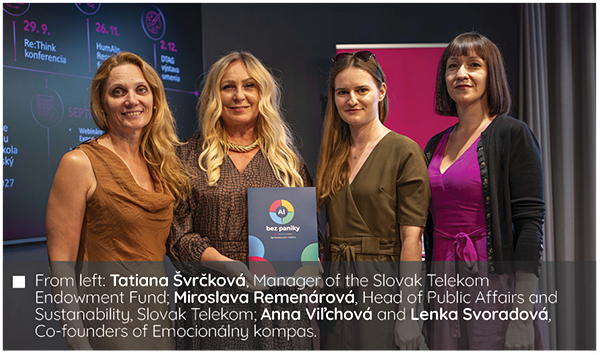
Miroslava Remenárová, Head of Public Affairs and Sustainability, Slovak Telekom
Author

- Miroslava Remenárová
- Slovak Telekom, a.s.
- Head of External Communication and Public Affairs
Follow us