
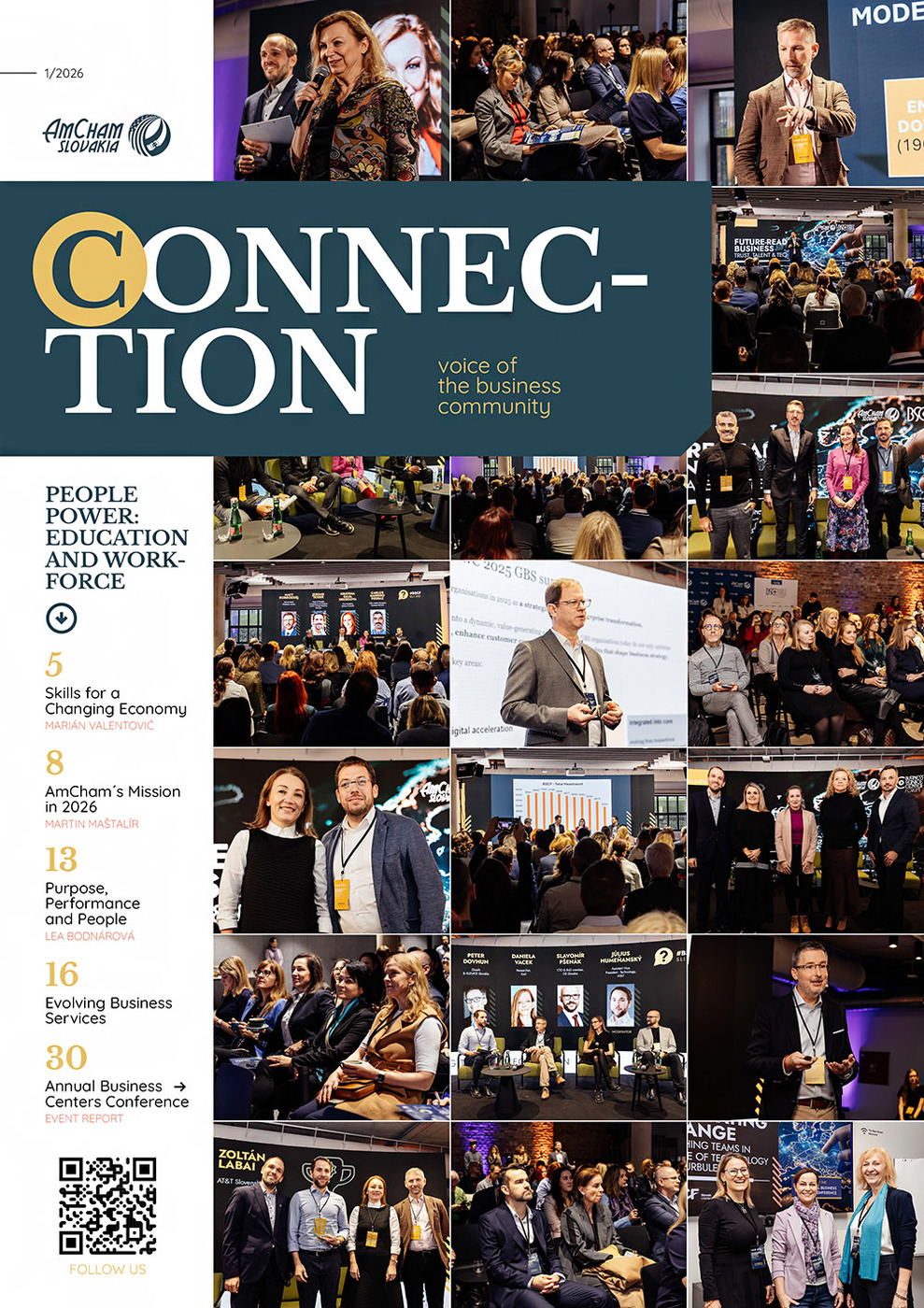
Download PDF
- Skills for a Changing Economy
- AmCham´s Mission in 2026: Competitiveness as Commitment
- Learning for Tomorrow
- The AI Adoption Gap
- Talent Garden: Blooming Local Talent
- Purpose, Performance and People
- From Cost to Capability
- Evolving Business Services
- Redefining Work and HR
- Skills Over Titles
- Work and Life Connections
- The Power of Business Districts
- Key Attributes of Leadership
- Equal Pay Reality
- The Pay Transparency Era
- When Antitrust Enters the Workplace
- Human-Agentic Workforce Revolution
- Strength in People
People Power: Education and Workforce
Skills for a Changing Economy
The first fact to acknowledge is the fundamental transformation Slovakia
is facing. Challenges that no European country can avoid: shortages of
skilled labor, demographic change, and accelerating technological
progress, are reshaping labor markets across the continent. If Slovakia
is to remain competitive, it must fully recognize and strengthen its
most valuable resource: human capital. As a country, we must focus on
developing the potential of the people we already have.
AmCham´s Mission in 2026: Competitiveness as Commitment
Dear Members, As we open the first issue of Connection in 2026, I would
like to take a moment to reflect on where we stand as a community and,
more importantly, where we are heading together. The turn of the year is
always an opportunity to pause, look back at what we have built, and
refocus our energy on the priorities ahead. This year, that focus is
clearer than ever: competitiveness.
Learning for Tomorrow
The world of work has never changed as fast as it is changing today. Artificial intelligence, digitalization and demographic shifts are reshaping our jobs and the way we learn and progress throughout our careers.
The AI Adoption Gap
The World Economic Forum’s Future of Jobs Report 2025 laid out the core skills workforces will need by 2030: analytical thinking, digital fluency, AI literacy, creative problem-solving, and collaboration. But the catch: even non-technical roles require technology design and programming skills. Two AmCham members, Clarios Slovakia and Restartup, partnered to turn this challenge into action. Ivana Rybanská sat down with Michal Guštafík (MG) and Miriam Lásková (ML) of Clarios, and Michal Novota (MN) of Restartup to discuss their approach.
Talent Garden: Blooming Local Talent
What happens when you give ambitious students real challenges instead of hypothetical case studies? You get Talent Garden, a unique program that turns Slovakia’s brightest minds into creators, innovators, and problem-solvers.
Purpose, Performance and People
In the shifting landscape of the current digital era, modern enterprises and particularly Business Service Centres (BSCs) in Slovakia are undergoing transformation. No longer confined to the periphery of corporate structures as back-office support units, advanced centers are reinventing themselves as high-value hubs.
From Cost to Capability
At AmCham Slovakia’s BSCF Conference, Peter Mrnka of PwC presented the key findings of the PwC 2025 Global Business Services (GBS) Survey, offering a timely snapshot of how GBS organizations are evolving in an increasingly volatile, digital, and talent-constrained world.
Evolving Business Services
The Business Services Center Forum (BSCF) Conference once again confirmed that the shared services and business centers sector remains one of the most resilient and strategically important pillars of the Slovak economy. At the beginning of the conference, BSCF Chair Marek Chudík, presented the key findings of the Annual BSCF Survey, offering a data-driven snapshot of the sector’s current state and future direction.
Redefining Work and HR
The future of work is no longer a distant concept, it is already unfolding. Rapid technological progress, demographic shifts, and sustainability imperatives are forcing organizations to rethink how work is designed, how talent is acquired, and how skills are developed. Continuous skills transformation has therefore become a strategic necessity rather than an optional investment.
Skills Over Titles
As technology evolves and AI, hybrid work, and shifting expectations reshape the workplace, traditional talent-management models, i.e., fixed roles, linear career paths, and isolated skill sets, no longer meet organizational needs. With many baby boomers retiring and younger generations (Gen Alpha) entering the labor market more slowly, the talent pool is shrinking just as the demand for adaptability rises.
Work and Life Connections
Achieving professional success often involves navigating many challenges.The responsibility towards their families and their employees makes business leaders carefully consider each minute of their day. We want to know how they like to spend their time out of work, what inspires them and motivates them.
The Power of Business Districts
Modern business districts have become key engines of economic performance in developed economies. Their significance extends far beyond real-estate metrics: they influence labor-market efficiency, innovation capacity and the overall competitiveness of cities navigating global economic pressures.
Key Attributes of Leadership
Tony Blair, who served as Prime Minister of the United Kingdom, writes in his book On Leadership: Lessons for the 21st Century: “Leaders willingly take responsibility upon their shoulders when passes around, step out when others step back, have the courage not to go with the flow, they speak up when others stay silent, they act when others hesitate, they take risk because they believe a higher purpose means the risk should be taken.”
Equal Pay Reality
Pay transparency has become one of the defining topics within AmCham Slovakia’s People Pillar, reshaping how employers approach remuneration, fairness, and trust. To unpack what the EU Pay Transparency Directive means in practice, we spoke with a true expert: Katarína Matulníková, Managing Partner at Wolf Theiss and Chair of AmCham’s Employment and Social Affairs Committee.
The Pay Transparency Era
In June 2026, Slovakia will enter a new era of pay transparency, aligning with the EU directive aimed at closing gender pay gaps and increasing fairness in remuneration. But far from being a mere compliance exercise, the reform is poised to reshape HR strategy, corporate culture, and the talent market itself.
When Antitrust Enters the Workplace
In 2009, fifteen hospitals in the Netherlands signed an agreement titled “Working Together, Training Together”. In the face of a shortage of professionals in certain positions and pressure to raise wages, the hospitals agreed not to rehire anesthetists and surgical assistants who left any of the cooperating institutions to work for a temporary employment agency or establish themselves as self-employed individuals for 12 months.
Human-Agentic Workforce Revolution
The way we work is changing faster than ever. Agentic AI isn’t just another tech trend, it’s about creating a workforce where humans and intelligent digital agents collaborate seamlessly. This shift promises speed, creativity, and adaptability like never before. Here’s what it means and why it matters.
Strength in People
The beginning of a new year is often a moment to look ahead rather than
back, to assess the forces shaping the business environment and consider
how they intersect with long-term priorities.
Follow us