
According to the World Economic Forum’s Future of Jobs Report 2025, employers expect that by 2030, up to 40 per cent of the key skills needed in the labor market may change. To stay competitive, companies will have to manage a massive wave of reskilling and upskilling.
In other words, what we know today may not be enough tomorrow. And that applies not only to programmers and analysts, but also to people working in administration or services. Corporate learning is no longer a “nice-to-have” benefit, it is becoming an essential condition for competitiveness.
The skills that will matter
There is one thing international reports agree on: the future of work will not be just about technical knowledge. In their summaries this year, both LinkedIn and Coursera highlight not only AI and digital literacy, but also analytical thinking, the ability to learn quickly, complex problem-solving and collaboration across teams.
Technology is changing fast, but what remains essential is people’s ability to navigate that change: to ask questions, understand contexts, and explain the impact of decisions to colleagues or customers. Soft skills are paradoxically the prerequisite for turning the new “hard” tools into something truly meaningful.
Most employees want to learn A survey by Alma Career across eight European countries shows that people are motivated by the chance to do jobs that allow them to grow. Mandatory training and one-off events, so far the dominant form of training in companies, are seen more as a chore than as something that genuinely benefits their careers.
The data also shows that most employees see learning as important, yet only some get the opportunity to pursue it at work. There is a large gap between what they want and what they are getting. And this is precisely where there is room for change.
Trends in corporate learning today
At the prestigious Learning Technologies conference in London, it has become clear that companies are moving away from the model of “one big training session per year”. They are beginning to prefer shorter, practical formats, which they try to build into a coherent system.
Microlearning is a response to a reality in which people are overwhelmed by meetings, emails and notifications. It is easier for them to find time for a five-minute video once a day than to sacrifice an entire working day for an occasional workshop.
A second trend is personalization. Instead of one universal set of courses for everyone, companies are building learning ecosystems. Employees have access to various types of content and can put together their own pathway that is aligned with their role, level or career plans.
Artificial intelligence is taking on an increasingly important role. In online learning, AI assistants are emerging that recommend courses based on what a person has already completed, what they are working on or what position they are applying for.
Working with data is important too. Modern learning does not just keep track of how many people signed up, it monitors how courses affected performance, satisfaction or a team’s ability to master new tools. This helps companies distinguish between programs that simply meet formal requirements and those that genuinely support the business.
What’s in it for companies and individuals?
For businesses, a skills-first approach primarily means greater resilience to change. Organizations that can quickly boost their people’s skills face fewer problems with shortages of specialists on the labor market.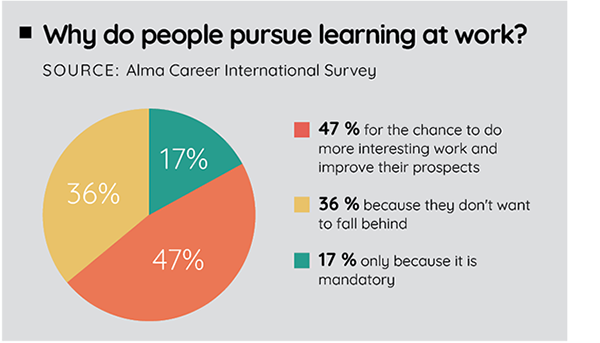 In practice, this does not just require a larger training budget, but above all a clear strategy. People develop faster in companies that have defined the key skill sets needed for the coming years, involve managers as partners in learning, combine formal courses with on-the-job learning (projects, shadowing, mentoring), and openly communicate why they are investing in learning.
For individuals, the changing world of work represents both a challenge and an opportunity. Specialist knowledge gained in secondary school or university has a shorter shelf-life than before, but at the same time it has never been easier to learn.
Regular microlearning, online courses, internal projects or mentoring can bring significant progress overall, even if each individual step may seem to deliver only small gains.
Learning as an advantage
Debates about the future of work often pit technology against people. Yet companies’ experience shows something different: those that perform best are the ones that can combine new tools with human skills.
The future of learning is therefore not just about whether companies buy another e-learning platform. It is about shifting the mindset from thinking “we need to complete mandatory training” to asking “what skills do we need to ensure that our people and the business are thriving in five years’ time?”
Wherever these questions are addressed systematically, and where people have the power to influence their own development, learning becomes a genuine competitive advantage.
Žofia Hrebíčková, B2B Marketing Strategist, Alma Career Slovakia

Follow us