
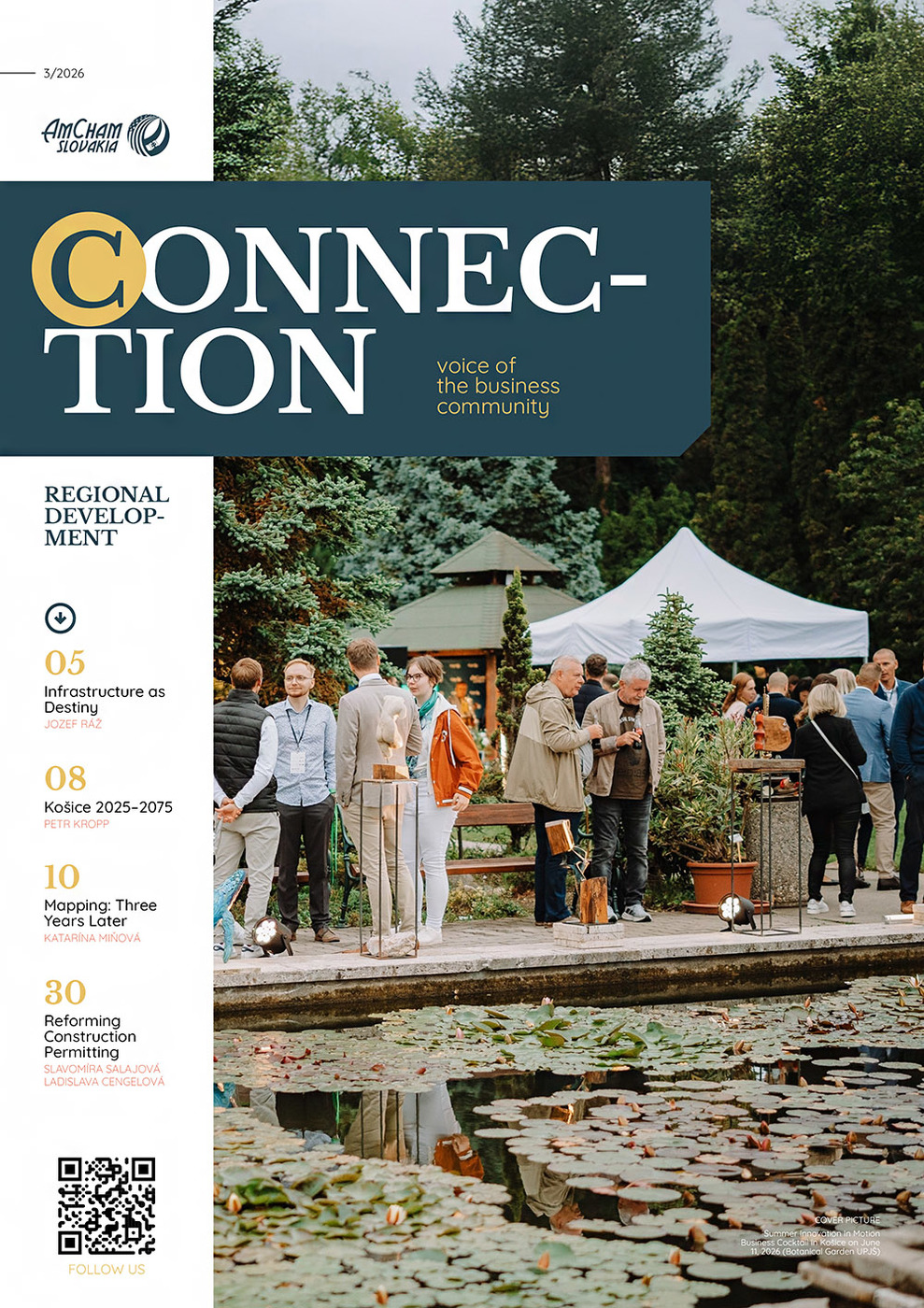
Download PDF
- Infrastructure as Destiny
- Mapping: Three Years Later
- Capital of Opportunity
- Košice 2025–2075
- Brownfield Transformation
- East Through Data
- Keeping Talent in the East
- A Catalyst for Growth
- Driving Regional Growth
- Two Regions, Two Paths
- One Region, Too Many Voices
- Rebuliding Ukraine: Opportunities
- Building Regional Champions
- Events Driving Growth
- Navigating Funding Opportunities
- Bridging Slovakia and Texas
- From Plans to Homes
- Growth with Character
- Reforming Construction Permitting
- Construction Reform Review
- Work and Life Connections
- Customer Care from Prešov
- Think Christmas Now
- Vision 2030: Digital Immunity
- The Kempinski Difference
- New Inheritance Rules
- Building Export Competitiveness
- Closing the Infrastructure Gap
- Building Act Reality
- Urban Living Redefined
- Unlocking the Momentum
Regional Development
Infrastructure as Destiny
There is a question I am often asked: why does Slovakia still seem to
operate at two different speeds? Why does economic vitality seem to
concentrate in the west while entire regions in the east wait — for
investment, connections or opportunity? My answer is always the same.
For too long, infrastructure has been treated as a consequence of
development rather than its foundation.
Mapping: Three Years Later
When AmCham Slovakia launched the Mapping the Potential of Eastern Slovakia initiative in 2023, the goal was to create a platform for meaningful dialogue among key regional stakeholders and identify concrete steps that would help unlock the full potential of Eastern Slovakia.
Capital of Opportunity
Slovakia and Europe are facing a series of interconnected challenges that reinforce one another. Europe is losing competitiveness, struggling to keep pace technologically with the United States and China, experiencing slower economic growth, and facing an aging population.
Košice 2025–2075
Today, Košice stands at the threshold of new challenges. Demographic and economic shifts, climate change, housing affordability, the quality of public spaces, and the need for sustainable mobility all require new approaches to urban development.
Brownfield Transformation
Bratislava is undergoing an important shift in how it approaches urban development. For much of the post-1989 period, the Slovak capital developed rapidly, but often without a clear long-term urban vision. Like many Central European cities, Bratislava experienced suburban expansion, fragmented growth and the transfer of strategic sites into private ownership with few conditions attached.
East Through Data
Eastern Slovakia stands at a pivotal moment. While the region shows clear signs of economic potential in the form of new investments, a growing tech sector, and strong urban centers, it continues to face structural challenges that limit its long-term development. The data below reveals a complex reality: progress and stagnation exist side by side.
Keeping Talent in the East
The prosperity of Slovakia hinges on bridging regional gaps by transforming Eastern Slovakia into a magnet for skilled professionals. By prioritizing career growth, smart specialization, local ecosystems and quality of life, the region can evolve from a “labor exporter” into a globally competitive business hub.
A Catalyst for Growth
The arrival of Volvo Cars in eastern Slovakia represents one of the most significant investments in the region’s recent history. While the full economic and social impact will only become clear over time, expectations are high. We spoke with Marc Gombeer, Plant Manager of Volvo Car Košice, about the project’s progress, lessons learned and its long-term ambitions for the region.
Driving Regional Growth
A key way to support economic growth and enhance the competitiveness of Eastern Slovakia is to actively stimulate business investment. Through direct and indirect state aid, companies can accelerate returns on their investments and strengthen their business activities.
Two Regions, Two Paths
As an auditor and consultant, I have spent the past 30 years traveling across Slovakia. Over time, I have become convinced that a strong Slovakia must be built on strong regional centers: Bratislava, Žilina, the Košice–Prešov metropolitan area, and the Banská Bystrica–Zvolen conurbation.
One Region, Too Many Voices
Eastern Slovakia has a strong story to tell: real industry, fast-growing IT, three universities, and a compact, livable city that offers most of what the West does at a lower cost. The problem is that everyone tells their own story.
Rebuliding Ukraine: Opportunities
Rebuilding Ukraine will cost $588 billion over the next decade, according to the World Bank Group. A recent Citi Institute report, Rebuilding Ukraine1, argues that Ukraine’s post-conflict recovery presents an era-defining economic opportunity for the private sector – and countries in Central and Eastern Europe could play a distinctive role.
Building Regional Champions
As an auditor, entrepreneur, and advisor, I have had the opportunity to observe the transformation of Eastern Slovakia from multiple perspectives. Leading TPA Slovakia’s Košice office and co-founding GetFinDone has reinforced my conviction that the region’s future depends not only on investment, but on helping ambitious local companies scale and succeed.
Events Driving Growth
One of the most impactful and frequently underestimated segments of the tourism industry operates largely behind closed doors: the world of business events. Congresses, conferences, incentive trips, and corporate gatherings represent a distinct category of visitor activity, one that carries significant economic weight and long-term strategic value for any destination that chooses to cultivate it seriously.
Navigating Funding Opportunities
Slovakia is entering a period in which competitiveness will depend less on low-cost production and more on the ability of companies, institutions and regions to adapt to global change. Technological transformation, energy security, supply-chain restructuring, climate obligations, labor shortages and the new European security environment are reshaping investment priorities.
Bridging Slovakia and Texas
During her business trip to the U.S., AmCham Slovakia’s Executive Director Martina Slabejová met Slovak couple Andrea and Jozef Hrušovský, who have been based in Austin, Texas, helping Slovak companies navigate the US market and build transatlantic business connections. We asked them to share their experience and perspective on regional competitiveness, investment potential, and opportunities for stronger economic ties between Texas and Eastern Slovakia.
From Plans to Homes
Across Europe, housing has become one of the defining policy challenges of the decade. It shapes labor mobility, economic competitiveness, and increasingly determines whether young people can afford independent living. The pressure is especially visible in Central and Eastern Europe.
Growth with Character
DYNAMIK began as a small construction business in Nitra. Today, it operates beyond Slovakia and ranks among the leading players in Slovak construction. CEO Vladimír Vikor Jr. says that the growth of a family business is not only about contracts, turnover and new markets. It is just as important to preserve trust, clear rules and the ability to make decisions the company can stand behind even ten years later.
Reforming Construction Permitting
Several months after the introduction of the new Construction Act, attention is shifting from legislative intent to practical implementation. While the reform promises faster, more transparent, and increasingly digital permitting processes, its long-term impact will depend on implementation. We asked Slavomíra Salajová and Ladislava Cengelová to assess the progress made so far and the challenges that remain.
Construction Reform Review
As of 1 June 2026, fourteen months have passed since the entry into force of the new Construction Act No. 25/2025 Coll. and selected implementing decrees. The reform introduced significant innovations, including digitalization, new terminology, changes to the content of design documentation and permitting, and revised definitions of minor and simple structures.
Work and Life Connections
Achieving professional success often involves navigating many challenges.The responsibility towards their families and their employees makes business leaders carefully consider each minute of their day. We want to know how they like to spend their time out of work, what inspires them and motivates
them.
Customer Care from Prešov
In Prešov, SWAN has gradually built a technology-driven customer care center that employs almost one hundred people and combines expertise, data and AI. The goal is not to replace people with technology, but to create more advanced services and support the region where SWAN has established a strong presence. We spoke with Róbert Plonka, Director of Customer Care at SWAN.
Think Christmas Now
In an increasingly digital world, physical brand experiences are gaining renewed importance. Diana Hauerland, CEO of Hauerland, explains how merchandise has evolved into a strategic communication tool, helping companies build lasting connections, strengthen brand identity, and create meaningful touchpoints with clients, partners, and employees.
Vision 2030: Digital Immunity
A conversation with Hana Kvartová, Chief Commercial B2B Officer at Orange, explores the company’s vision for 2030 and how digital transformation is reshaping business infrastructure, cybersecurity, and cloud strategy. As she points out, automation, connectivity, and resilient digital ecosystems will enable enterprises to compete in an AI-driven economy of the future.
The Kempinski Difference
Let’s be honest, when someone mentions a corporate event, the first image that comes to mind is rarely an inspiring one. A conference room with questionable air conditioning, a PowerPoint presentation that could have been an email, and a team-building activity so painfully contrived it makes even the most enthusiastic colleagues reach for their phones.
New Inheritance Rules
Slovakia is undergoing one of the most significant overhauls of private law in decades. The new Civil Code will replace the 1964 code with a modern framework bringing major changes in inheritance, contract law and beyond, with real consequences for everyone.
Building Export Competitiveness
In today’s global economy, competitiveness is shaped not only by the quality of products and services, but increasingly by the quality of the environment in which companies operate. Infrastructure, logistics connectivity, industrial capacity, energy reliability, and efficient development processes have become important factors influencing long-term economic performance and export competitiveness.
Closing the Infrastructure Gap
According to data from the Road Database of the Slovak Road Administration, as of January 1, 2026, Slovakia had 559.4 km of motorways, 347 km of expressways, and 3,336.4 km of first-class roads in operation. For comparison, Slovakia and Poland were at a similar level of motorway development in 2004, but Slovakia has since fallen behind.
Building Act Reality
The new Building Act No. 25/2025 Coll. is a step in the right direction. Combining zoning and construction proceedings into one, reducing bureaucracy, and digitizing processes are goals the real estate development community fully supports.
Urban Living Redefined
The way people live in cities is undergoing one of its most significant shifts in decades. Household structures are changing, labor markets are becoming more mobile, and younger generations have different expectations of urban life. At the same time, property prices and mortgage costs are rising, alongside growing pressure to improve the quality of urban environment.
Unlocking the Momentum
When I stepped into my new role at AmCham Slovakia this June, I expected
to meet engaged business leaders and interesting projects. What I did
not fully anticipate was the sheer scope and influence of our community.
In just a few months, through conversations with members and partners, I
have come to appreciate how strong AmCham’s position really is, and how
central innovation and regional development are to our shared agenda.
Follow us