
These trends are even more pronounced in Slovakia, where long-term challenges include the outflow of talented people, the departure of companies, and historically low levels of foreign investment. As many as 23% of Slovak students study abroad, the second-highest share in the European Union after Luxembourg, and many never return. According to VAIA, the loss of one educated young person represents an economic cost of up to €2.8 million1. The departure of skilled talent and high-value-added companies remains one of the greatest risks to Slovakia’s future prosperity.
These challenges are naturally reflected in Bratislava. Although the capital generates nearly one-third of Slovakia’s GDP and ranks among the EU’s strongest-performing regions, past success alone will not secure future competitiveness. Bratislava is competing for talent, investment, and innovation with cities such as Prague, Brno, Vienna, and Warsaw. Being the best city in Slovakia is no longer enough.
The city’s biggest challenge is not a lack of potential. Bratislava is home to strong universities, successful technology and manufacturing companies, a startup ecosystem growing by nearly 40% annually2, and a highly skilled workforce, with knowledge-intensive professions accounting for almost 25% of employment3. The problem is that these strengths are not always connected effectively, limiting their ability to generate new opportunities.
There are, however, many reasons for optimism.
Between 2019 and 2025, Bratislava invested a record €400 million in public transport, green spaces, public areas, sports infrastructure, transparency initiatives, and cultural offerings. The city has become safer, more open, and more attractive. Today, quality of life is one of the most important drivers of economic competitiveness.
Objective indicators support this positive trajectory. The Resonance Index ranks Bratislava among the most economically prosperous cities in Central Europe, while European Commission surveys consistently highlight the city’s strong social cohesion.4
Bratislava also benefits from a unique geographical position, within easy reach of Vienna, Brno, and Budapest. The city hosts growing companies in cybersecurity, artificial intelligence, robotics, biotechnology, and advanced services, alongside research institutions capable of competing internationally. Most importantly, it has a generation of young people eager to create, innovate, and build businesses.
Our ambition is to build on these strengths and establish Bratislava as a true capital of opportunity. A city where people want to study, work, do business, live, and raise families. A city that not only educates talent but also attracts and retains it. A city capable of creating and sustaining high-value-added businesses.
To achieve this, the city has partnered with Bloomberg Associates5 to develop a collaborative program bringing together the municipality, businesses, and universities around five strategic pillars focused on economic development, innovation, and talent.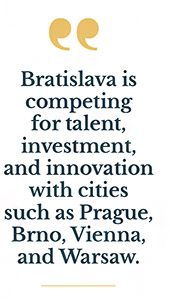 The first pillar is a systematic approach to talent retention and attraction. If thousands of Slovaks leave each year to study abroad, Bratislava must create compelling reasons for them to return. The city is strengthening cooperation between universities, students, and employers through internships, networking opportunities, and programs that demonstrate the possibility of building successful careers at home. Initiatives include Student Welcome Week, outreach visits to regional universities with employers, and new internship opportunities across city institutions.
The second pillar focuses on entrepreneurship and innovation. Bratislava needs more startups, more founders, and more young people willing to turn ideas into successful ventures. The city supports entrepreneurial education and facilitates collaboration between students, researchers, and businesses. Current initiatives include the Future Founders Varsity program, developed with The Spot, and the multi-year Climathon project organized with partners such as Swiss Re.
The third priority is attracting high-value-added investment. Bratislava can no longer compete on low labor costs. Instead, it must compete through talent, innovation, and quality of life. The city is therefore strengthening its investment promotion efforts, developing professional investor support services, and targeting projects that create high-quality jobs and bring valuable expertise. Key initiatives include building a clear international city brand and establishing a dedicated investment attraction team in cooperation with partners such as SARIO.
The fourth pillar focuses on helping Slovak companies scale. Too many startups relocate abroad precisely when they begin to grow. Bratislava aims to create conditions that enable them to expand internationally while remaining based in Slovakia. Existing initiatives include an accelerator program for impact scaleups developed with the Vienna Business Agency and the Scaleup Summit, designed to support local companies while also attracting promising firms from Ukraine and the Western Balkans seeking a gateway to European markets.
The fifth pillar builds on sectors where Bratislava already enjoys competitive advantages, including cybersecurity, artificial intelligence, robotics, biotechnology, and advanced services. The city’s role is not to manage these industries directly, but to connect businesses, universities, investors, and talent so they can grow more quickly and effectively.
Economic development is not an end in itself. It is a tool for improving people’s lives. A stronger economy creates greater resources for quality schools, affordable housing, better transport, more attractive public spaces, and a higher overall standard of living.
Bratislava is the economic engine of Slovakia. A stronger Bratislava means a stronger Slovakia. If we can transform brain drain into talent attraction, support the growth of innovative companies, and attract investment into the industries of the future, we can create a city that does more than adapt to global change — one that helps shape it.
***
- Výskumná a inovačná autorita (VAIA), 2023, Magnet for talent.
- StartupBlink, Global Startup Ecosystem Index, 2025.
- Nordic Capital, 2025, Brain Business Jobs Index, 8th edition
- European Commission, Report on the Quality of Life in European Cities, 2023.
- Bloomberg Associates is a philanthropic consultancy that works with cities around the world and is part of Bloomberg Philanthropies.
Ján Mazúr, Chief Strategy Officer of Bratislava, Bratislava - hlavné mesto SR
economy@bratislava.sk

Follow us