
The regions of eastern Slovakia represent a significant part of the country in terms of population, territory, and future growth potential; however, they have long faced lower economic performance compared to other regions. Experts primarily point to disparities in GDP per capita, weaker labor market dynamics, lower levels of infrastructure development, and the ongoing outflow of the active workforce to other regions or abroad. In my opinion, however, this “performance gap,” should not be viewed solely as a drawback; it also constitutes a strong rationale for targeted and strategic investments, as well as for more efficient use of available state aid instruments.
A key competitive advantage of eastern Slovakia lies in the combination of cost competitiveness, the availability of labor, and the capacity for further development of both industry and services. The region can build on its industrial tradition, existing supply chains, and a gradually developing technological base. Going forward, it will be essential to shift from a model primarily based on cost advantages toward one focused on higher value added, driven by the integration of manufacturing with research and development, digitalization, and the creation of proprietary know-how.
In this context, the overall business environment significantly depends on the synergy of several factors, particularly the availability of a qualified and cost-competitive workforce, the quality of infrastructure, a reasonable level of taxation and social contributions, and strategically designed state aid funding opportunities for businesses.
The European Union and the Slovak Republic support a wide range of investment activities, including the development of industrial production, technological innovation, infrastructure modernization, improvements in energy efficiency, the green transformation of businesses, as well as the development of skills and employment. It is important to emphasize that state aid is not aimed exclusively at large foreign investors but is equally accessible to small and medium-sized enterprises, including domestic companies.
The state, in its effort to support economic development, provides investment incentives for strategic and value-added projects, develops industrial parks and zones, and offers businesses a broad range of financial and non-financial state aid instruments. The current EU funding operational program is primarily focused on supporting research, development, and innovation, improving energy efficiency and the decarbonization of industry, environmental protection, as well as the development of transport and technical infrastructure and the reduction of regional disparities.
In addition to EU funding, companies can also benefit from regional investment aid, which is available for both new investment projects and the expansion of existing operations of established companies. This type of support is not tied to specific programming periods and is accessible to enterprises of all sizes, whether domestically owned or foreign-owned, investing in new capacities in industrial production, business service centers, or technology centers. 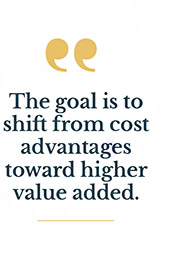 The support is primarily targeted at projects with higher value added and investments directed to priority districts, contributing to regional development and the creation of qualified jobs. Most districts in eastern Slovakia are classified as less developed regions, where the conditions for receiving regional investment aid are the most favourable and the maximum aid intensity is the highest.
Investments in research and development also play a significant role in enhancing the competitiveness of regions in eastern Slovakia. Companies engaged in R&D activities are allowed to claim an additional tax deduction on eligible R&D expenses (most commonly personnel costs) of up to 100%. The objective of this incentive is to encourage businesses to increase their investment in innovation, support the creation of high-skilled jobs, and strengthen the overall competitiveness of the economy. This regime applies nationwide, without sectoral limitations, and represents an automatically claimable instrument through the corporate income tax return. The resulting savings can subsequently be reinvested into further business development.
The future economic growth potential of regions in eastern Slovakia will be influenced not only by investment incentives and state aid, but also by the quality and availability of transport and technical infrastructure, the standard of the education system and its alignment with labor market needs, and the overall stability of the business environment. A positive development is that eastern Slovakia already hosts several strategically prepared sites and industrial zones that are being systematically developed to accommodate investors and support the implementation of their business activities.
These locations offer a suitable combination of infrastructure, workforce availability, and investment support. The entry of a major automotive investor into the region in recent years has demonstrated a strong multiplier effect—not only by generating new jobs but also by fostering the development of local supply chains, attracting additional investments, and creating synergies across related industrial sectors and services.
The success of investment policy in eastern Slovakia does not depend solely on the volume of available financial support, but primarily on its effective utilization, the quality of investment projects, and the ability to implement activities with higher value added. Experience shows that regional disparities can be gradually reduced; however, without high-quality human capital, well-functioning institutions, and a sustainable long-term investment environment, this process tends to slow down. The key is therefore to leverage the region’s competitive advantages and available state aid instruments as a springboard for transforming the economy towards higher value-added activities, while ensuring that the economic benefits generated remain within the region even after the support ends.
Milan Šustek, Director, Deloitte Slovakia

Follow us