
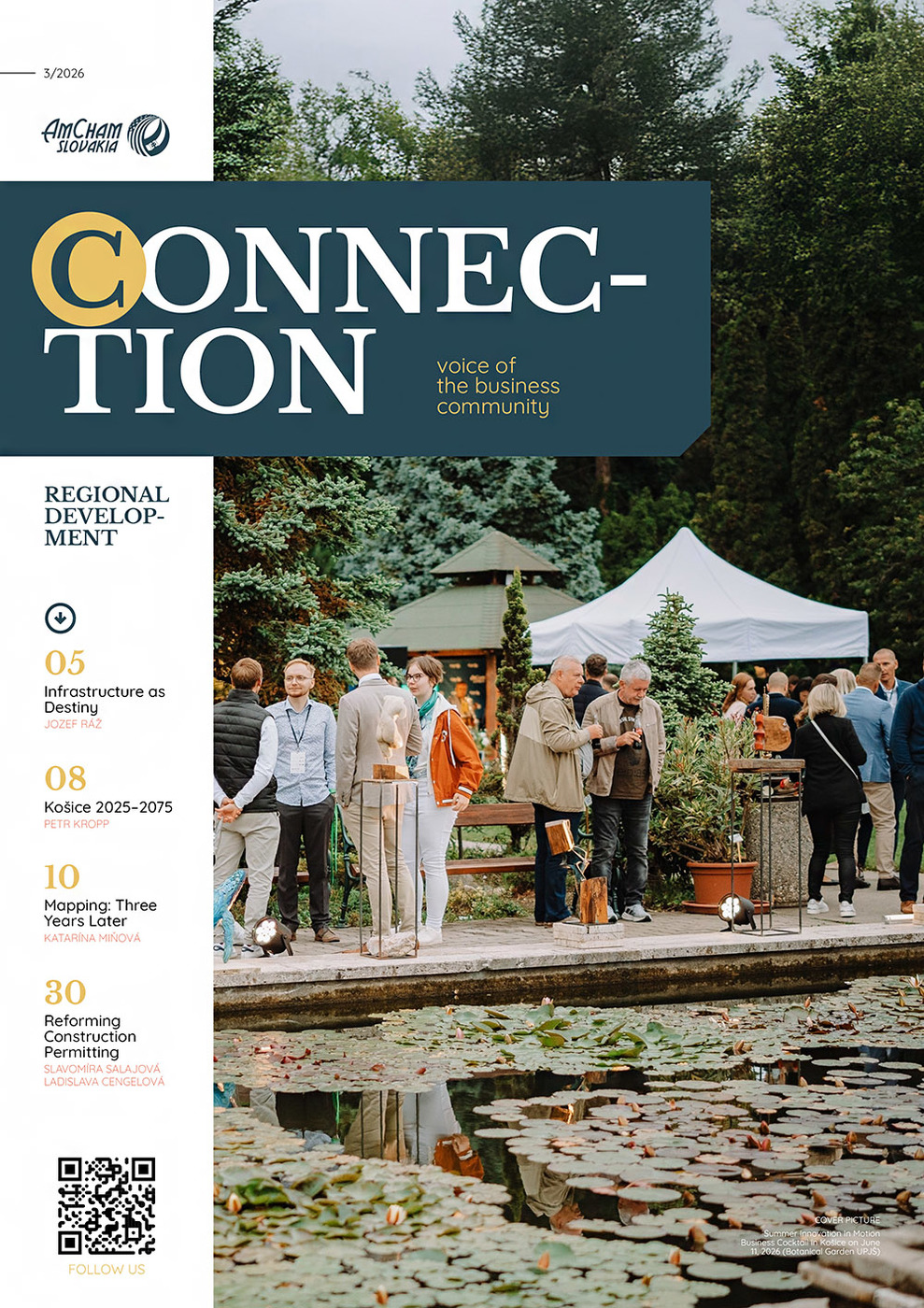
More than 120 representatives from the business community, local and regional governments, state institutions, academia, and civil society took part in the project’s three phases. The outcome was a set of 18 recommendations covering human capital, infrastructure, healthcare, innovation, regional attractiveness, and industrial development. These recommendations subsequently became an important advocacy tool for AmCham Slovakia.
Three years later, it is worth asking a simple question: Are these recommendations still relevant?
The answer is undoubtedly yes. At the same time, the region has undergone significant change. Eastern Slovakia is experiencing one of the most dynamic periods in its modern history. The arrival of strategic investors, the growth of the innovation ecosystem, Košice’s rising importance as a technology hub, and emerging opportunities linked to Ukraine’s future reconstruction are creating an environment rich in potential.
Yet many of the challenges identified in 2023 remain. Their context has evolved, but their underlying nature has not.
One of the most discussed topics at the time was the need for a stronger identity and a shared story for Eastern Slovakia. The conversation about how to communicate the region’s story with a unified voice is even more relevant today. In a global competition for talent, investment, and attention, being a great place to live and do business is not enough. The region must also be able to communicate its strengths effectively while embracing what makes it unique. The objective should not be to create an idealized image of the region, but rather to build a brand that is authentic and credible. Košice possesses qualities that cannot simply be replicated elsewhere: a safe environment, strong personal connections, flexibility, and a high quality of life for families. Many international visitors describe the city as a unique combination of the advantages of a larger urban center and the close-knit relationships typically associated with smaller communities. These characteristics can form the foundation of a compelling narrative that helps the region compete for talent and investment.
At the same time, a strong brand must be supported by real-life experience. Employers increasingly point out that Košice still struggles to compete with Bratislava when it comes to career opportunities for partners and family members of international employees. As a result, discussions about regional attractiveness naturally extend to the quality of public services, leisure opportunities, and the overall experience of residents and visitors throughout the year.
Human capital remains equally important. Demographic trends are requiring particular attention. The number of secondary school and university graduates continues to decline, while many young people leave the region in search of opportunities abroad. Retaining talent, attracting new residents, and creating attractive conditions for both life and career development will remain among the most important determinants of the region’s future competitiveness.
This is why many of AmCham’s follow-up activities focused on the employment of socially excluded communities and the integration of people arriving from Ukraine.
Discussions with experts confirmed that solutions exist. Their implementation, however, requires long-term cooperation among employers, local governments, educational institutions, non-governmental organizations, and the state. Employment is ultimately connected to the region’s ability to create opportunities for everyone who lives here or chooses to build their future here.
The importance of this issue is highlighted by the hiring plans of Volvo Cars. While the company currently employs approximately 200 production workers, it plans to recruit another 800 employees by the end of 2026 and an additional 700 during 2027. Once the plant reaches full production, it is expected to employ around 5,400 blue-collar workers and another 400 white-collar professionals.
Volvo’s ambition is to create opportunities primarily for people living across Eastern Slovakia. This brings renewed attention to regional mobility, housing availability, and the connectivity between Košice and more remote areas of the Košice and Prešov regions. Enabling people from cities such as Michalovce, Humenné, Trebišov, Rožňava, or Bardejov to access quality employment opportunities may prove just as important as the investment in manufacturing facilities themselves.
This is where another recommendation from the original project becomes particularly relevant: the creation of a regional labor market platform. While discussions on this topic already take place at the regional level, there is still considerable room for stronger cooperation between employers, educational institutions, and public authorities. The region needs better data on future workforce shortages and more effective mechanisms for translating these insights into educational planning and decision-making.
Another recurring topic in discussions among AmCham members concerns the functioning of institutions that foreign employees and their families interact with. Employers continue to report that immigration-related administrative processes are often lengthy, rigid, and unnecessarily burdensome. If the region wishes to compete successfully for international talent and attract members of the Slovak diaspora back home, the quality of public services will be just as important as the job opportunities themselves.
In this context, the establishment of Brainport Košice under the leadership of Business Košice represents a positive example of how recommendations can be transformed into practical solutions with broader regional potential. Back in 2023, experts involved in the project highlighted the need for a soft-landing platform that would help attract international talent, returning Slovaks, and skilled professionals while supporting their integration into the region. Founded by Business Košice, an organization established by the City of Košice, Brainport Košice is one of the outcomes of this discussion. The platform provides practical information on employment, housing, education, healthcare, and everyday life in the city for international professionals, students, and returning Slovaks. A natural next step will be expanding this approach to other parts of the region, including Prešov, and gradually creating the foundations for a truly regional East Slovak Brainport.
The ability to connect stakeholders was one of the core objectives of the Mapping the Potential of Eastern Slovakia initiative from the very beginning. The original document emphasized that trust and open cross-sector communication are essential prerequisites for successful regional transformation. Today, that message may be even more relevant than it was three years ago.
The experience of successful European regions shows that competitiveness is built not only on infrastructure and investment, but also on the quality of cooperation among public institutions, businesses, and academia. Regions such as Brno, Ostrava, Katowice, and Wrocław have created environments where stakeholders communicate regularly, coordinate their activities, and jointly define development priorities.
Eastern Slovakia has the potential to follow a similar path.
Through expert discussions, working groups, conferences, and networking events, AmCham Slovakia continues to create opportunities for representatives of local governments, businesses, academia, and civil society to come together. These meetings foster dialogue, build trust, and create partnerships—essential ingredients for long-term regional development.
As local elections approach, this is an appropriate moment to revisit the recommendations developed through the Mapping the Potential of Eastern Slovakia initiative and reflect on the priorities that should shape the region’s future.
Some recommendations have moved closer to implementation. Others remain open. New challenges have emerged as well, including housing availability, the functioning of institutions serving foreign workers, and the continued outflow of talent from the region.
To remain relevant in the years ahead, the initiative will need to continuously adapt its perspective on emerging opportunities and challenges. Eastern Slovakia stands at the intersection of several major trends: industrial transformation, energy security, digitalization, demographic change, and Ukraine’s future reconstruction.
Its geographic location provides a unique opportunity to become a gateway for economic cooperation with Ukraine, a logistics and innovation hub for reconstruction projects, and an energy corridor connecting the European Union with its eastern neighborhood. Realizing this potential will require continued investment in transport, energy, and digital infrastructure, systematic development of human capital, and effective coordination among cities, regions, national authorities, and the private sector.
In this regard, AmCham Slovakia can continue to play an important role as both an advocate for its members and a platform connecting different sectors and levels of governance. The future competitiveness of Eastern Slovakia will depend on long-term partnerships among businesses, local governments, academia, and civil society. The challenge ahead is not only to implement existing recommendations but also to identify new priorities, from demographic development, energy resilience and resource availability to innovation, talent attraction, and active participation in Ukraine’s reconstruction.
If Eastern Slovakia succeeds in maintaining an open dialogue and a shared vision for development, it has every opportunity to become one of Central Europe’s most dynamic regions. Achieving this will require cooperation, trust, and the willingness to think beyond organizational boundaries and electoral cycles.
This is precisely why Mapping the Potential of Eastern Slovakia remains relevant today. It continues to provide a framework for discussion, collaboration, and the shared effort to shape the region’s future.
The original 18 recommendations revealed in January 2024
Katarína Miňová, University Teacher, UPJŠ Košice
Author

- Katarína Miňová
- American Chamber of Commerce in SR
- Project & Event Manager Košice
Follow us