
Strong City, Weaker Region
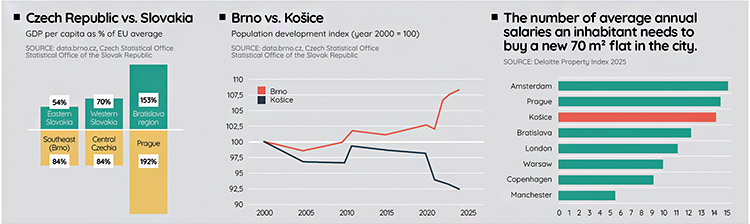
Eastern Slovakia produces nearly 12% of Slovakia’s GDP (Statistical Office of the Slovak Republik, 2026), yet the Košice region ranks only 5th in economic strength and growth.
This contrast highlights one of the region’s defining paradoxes: economic relevance without corresponding regional performance. Košice serves as a strong urban center, concentrating investment, talent, and institutions. However, this strength does not sufficiently spill over into surrounding areas.
The same contrast can be seen in the labor market. In Košice, unemployment stands at 3.4%, compared to 6.2% in the wider region. This difference illustrates a clear duality: a relatively balanced urban job market versus structural challenges in the broader region.
The gap between city and region suggests a missing “transmission mechanism.” Economic growth in Košice does not automatically translate into broad regional prosperity. The data also points to long-standing structural issues including the neglect of marginalized populations and people with lower levels of education, insufficient connectivity, weak institutional cooperation, and fragmented regional development. Eastern Slovakia’s challenge is not a lack of potential, but a lack of cohesion in turning that potential into sustained development.
Demographic Decline and Migration Pressure
Košice lost more than 1,400 inhabitants in 2025, with both natural decline and migration contributing to the drop. The numbers reveal a deeper structural issue: the region is not only ageing but also losing people through migration. Approximately 800 people left due to migration alone, indicating that the challenge is not purely demographic.
This trend reflects the region’s limited ability to retain talent. Even where economic opportunities exist, they are not sufficient to keep people long term. Housing availability, career prospects, and quality of life all likely play a role.
The comparison with Brno is particularly telling: while Košice experienced an 8% population decline, Brno recorded an 8% increase over a comparable period. This divergence underscores the importance of attracting and retaining young, productive populations. Reducing administrative barriers for Ukrainian people and skilled migrants could help Eastern Slovakia address demographic decline and labor shortages.
Talent Pipeline Under Pressure
The number of graduates in the region has declined significantly. Between 2015 and 2025, total graduates dropped by 23%, with university graduates decreasing by 34%. (CVTISR - Slovak Centre of Scientific and Technical Information, 2026)
This trend represents a weakening talent pipeline at a time when knowledge-based industries are becoming increasingly important. The decline affects all levels of education, including vocational schools and gymnasiums.
At the same time, approximately 25,000 Slovak students study in the Czech Republic, reinforcing the brain drain challenge. Even regions that generate skilled graduates often fail to offer sufficient opportunities to keep them. This creates a double loss: fewer graduates overall and an outflow of those who are most competitive. To reverse this trend, Eastern Slovakia will need to align education, employment opportunities, and quality of life into a coherent “talent ecosystem.”
Housing Affordability as a Hidden Barrier
Housing affordability is emerging as a critical challenge. In Košice, the average price per square meter has reached €3,148, while affordability indicators rank the city among the least accessible markets, even compared to cities like Bratislava or London. This is a striking finding. It suggests that despite lower average wages, the cost of housing creates a disproportionate burden on residents. Such conditions can significantly influence migration decisions, particularly among young professionals.
When employees cannot secure affordable housing, companies face increased difficulty in attracting and retaining talent. This directly impacts competitiveness, especially in sectors requiring skilled labor.
Closing
The data paints a clear picture: Eastern Slovakia is not a region lacking opportunities, but one struggling to transform them into long-term outcomes. Bridging gaps between city and region, talent and jobs, and growth and quality of life will determine whether the region remains a promise, or becomes a success story.
Miriam Šebová, Associate Professor, Faculty of Economics TUKE

Follow us